

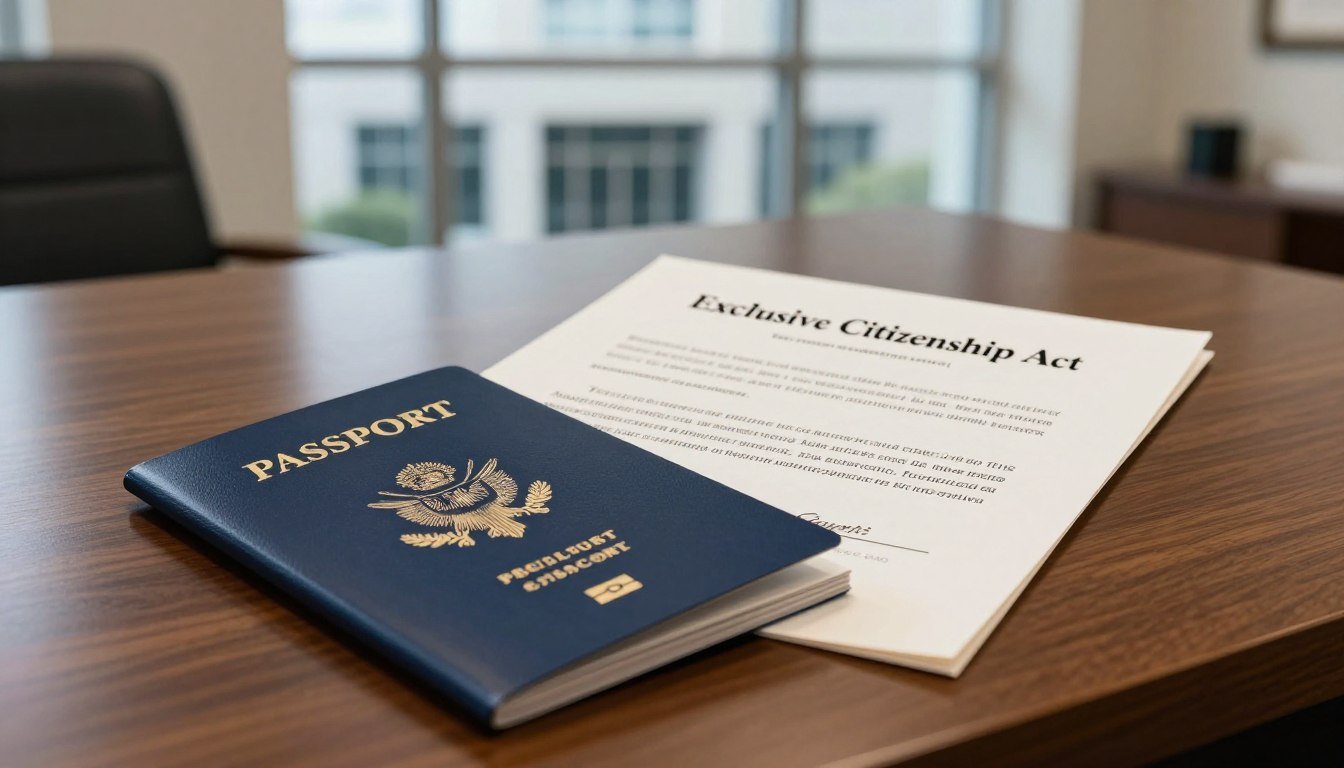
Picture this: you’re trying to book a flight and your feed erupts with “dual citizenship ban U.S.” like it’s a seat sale. I did a double-take, too—until I remembered headlines love drama more than details.
I’ll say it plainly: the Exclusive Citizenship Act is a proposal that would push people to pick one nationality or risk having their U.S. status called into question. The draft talks about “sole and exclusive allegiance” and warns some passports could be made null and void if folks don’t choose.
Before you cancel your trips: current State Department guidance says U.S. law does not force people to choose between nationalities. That matters—a lot.
This intro will be your calm briefing. We’ll cover what the bill actually says, who introduced the proposal, how enforcement might look, and why court challenges matter more than group-chat hot takes.
Key Takeaways
- Don’t panic: a bill is not law, and the State Department still says choosing isn’t required.
- The exclusive citizenship act proposal aims to require sole allegiance; it could threaten some passports if enacted.
- Travel, taxes, and family ties are at stake—this isn’t just airport drama.
- Legal challenges are likely; courts matter more than viral clips.
- Stay ready: follow official guidance and credible reporting, not rumor mills.
What’s driving concern among American travelers right now
Think of it like someone wobbling the travel table while you’re carrying soup and a boarding pass. Even a suggestion that a long-standing rule might change can send practical plans into chaos.
Who’s watching? People who split time across borders — dual nationals, expats, frequent flyers, and families with mixed ties — are all paying attention. Their lives depend on easy entry, work rights, and predictable residency rules.
Why this matters now
For decades the united states has tolerated multiple passports, and that quiet norm let many plan long stays, school years, and careers abroad.
Now a single high-profile policy proposal changed the conversation. Headlines made it feel immediate, even when the law hasn’t. That pressure is enough to affect renewals, bookings, and long-term moves.
The emotional and practical math
- If your life runs on two documents, a rumor feels like someone shook the table.
- Airlines won’t accept “it’s complicated” at check-in — passports must be clean and ready.
- Expats worry about work authorization, residency, and their kids’ school years.
“A proposal can tilt plans even before it becomes law.”
Bottom line: Treat the chatter as a prompt to check your documents and get clear, official guidance — not a reason to panic at 3 a.m.
What is the Exclusive Citizenship Act of 2025?
Let’s cut through the legalese: what this proposal actually demands. At its core, the exclusive citizenship act would force people to owe sole and exclusive allegiance to the United States.
The phrase sole exclusive allegiance sounds fancy, but it means one thing in plain language: the law would require your legal loyalty to be monogamous. No back-and-forth between nationalities would be permitted for people who want to keep U.S. status.
The practical change
Right now, many people hold more than one nationality and manage overlapping obligations. This proposal would redraw the line.
- Keep U.S. citizenship by formally renouncing the other nationality.
- Or keep the other nationality and be treated as having given up U.S. status.
“It creates a two-lane choice: pick the United States or pick another nation.”
| Before | After (proposal) | Practical effect |
|---|---|---|
| Many people tolerated holding two nationalities | Citizens must show sole exclusive allegiance | Renounce the other nationality or lose U.S. status |
| Passports treated as travel documents | Focus shifts to legal nationality status | Owning a foreign passport could trigger loss rules |
| Flexible real-world arrangements | Clear legal line on acceptable nationality | Big lifestyle and legal changes for many people |
Remember: this is a proposed law, not final. The details matter, and rest of the article looks at who put this forward and why.
Who introduced the bill and what Senator Bernie Moreno says it’s aiming to do
Sen. Bernie Moreno, an immigrant who became a citizen at 18, is the sponsor behind the moreno bill. He says the measure is about plain loyalty and clear rules for who owes what to which country.
Moreno’s stated rationale
Moreno frames the proposal in three buckets: loyalty, national identity, and avoiding conflicts of interest. He argues that holding another nationality can create divided ties and murky duties.
Key quotes and public lines
“When I became an American at 18, I pledged my oath ONLY to this nation,” Moreno said. “It’s all or nothing.”
That “all or nothing” line (and the oath quote) is what turned this into a hot-button policy debate. Critics call it a loyalty test; supporters call it a straightforward standard.
Regardless of politics, the practical question for many americans is simple: what would this proposal do to real people? Next, we look at current law and government guidance.
Dual citizenship is currently legal in the United States
Here’s the simple baseline: holding more than one nationality is lawful in the united states right now. That baseline matters—because most panic starts when people forget what the law already says.
What the state says: the State Department expressly notes that “U.S. law does not require a U.S. citizen to choose between U.S. citizenship and another nationality… may naturalize in a foreign state without risk.” That official line beats rumor every time.

How people commonly end up as nationals of two places
- Birthright: born in the U.S. and also entitled to a parent’s nationality abroad.
- Parentage: citizenship passed down through a mother or father.
- Naturalization abroad: some people pick up another nationality while keeping their U.S. status.
- Naturalized Americans: immigrants who naturalize here but retain their original nationality where allowed.
The practical rule travelers live by
Short version: if you have two travel documents, enter and leave the U.S. on your U.S. passport. Border officials expect a clean record and a single document at entry/exit. Follow that rule and you avoid most headaches.
“Millions have built cross-border lives on this stable baseline—quirks included.”
| Situation | Current legal position | Traveler tip |
|---|---|---|
| Naturalizing abroad | Allowed without automatic loss of U.S. status | Keep proof of U.S. ties and use U.S. passport for U.S. travel |
| Birth or parentage | Often creates dual nationality at birth | Carry both documents; show U.S. passport entering/leaving |
| Foreign laws | Some countries bar multiple national ties | Check local rules before relying on both statuses |
Dual citizenship ban U.S.: what the bill would require if enacted
Imagine being told you have exactly 365 days to pick which legal identity stays.
Headline rule: under the proposal, you would need to formally renounce another nationality to keep your U.S. status and passport. If you don’t, the text says your U.S. citizenship and travel document could be forfeited.
The draft gives existing holders one year to act. That 12-month window sounds generous until you remember renunciation can take months — consulate appointments, forms, fees, and waiting lists.
“Written renunciation” is more than a note. Expect affidavits, notarized forms, and official certificates from the other state. Some countries block renunciation, require military clearances, or charge steep exit rules.
“It’s a blunt mechanism with real life fallout — visas, residency, and work rights all hang in the balance.”
| Requirement | What it means | Traveler impact |
|---|---|---|
| Formal renunciation | Signed, written proof from the other country | May break visa or residency ties |
| One-year decision window | 365 days to submit documentation | Fast action needed; plan travel and records |
| Practical hurdles | Consular steps, fees, foreign delays | Some citizens cannot renounce easily |
We’re still talking about a proposal, but the mechanism is sharp and the stakes are high. Next up: timelines and how officials would try to enforce this rule.
Key timelines and enforcement mechanisms in the proposal
Mark your calendars: the proposal sets a clear countdown that matters for anyone with ties to more than one country. The act 2025 would start with a 180-day runway before the new rule takes effect.
The 180-day runway before rules would apply
From enactment, agencies get 180 days to set procedures and notify the public. Think of that as polite warning time (with a ticking clock).
What happens after the one-year deadline expires
Existing holders get one year to provide proof of renunciation or other compliance. Miss the deadline, and the draft says you could be treated as having lost U.S. status.
“The proposal converts a policy choice into a calendar-driven legal test.”
Enforcement, in practice, would mean tracking filings, processing renunciations, and updating records in federal systems. That’s easier said than done — agencies must coordinate with consulates, update databases, and flag affected travel documents.
Where the enforcement question really bites is in the gray: how will officials identify noncompliance, and what checks protect people from mistakes? Those gaps are exactly where legal challenges will focus.
| Timing | What it requires | Practical enforcement steps |
|---|---|---|
| 0–180 days | Agency rulemaking and public notice | Publish procedures, set intake points, train staff |
| Year 1 (decision window) | Submit proof of renunciation or similar | Accept documents, verify foreign certificates, update records |
| After deadline | Noncompliant individuals treated as relinquished | Flag passports, revoke benefits, notify affected people |
How the proposal could affect Americans who later acquire another citizenship
What if that little application for ancestral nationality turned into a legal red flag?
The proposal says people who later acquire a foreign nationality could be deemed to have relinquished U.S. citizenship. In plain terms: get another nationality after the fact, and you might be treated as having given up your American status automatically.
Automatic-loss concept and real-life examples
This automatic-loss idea matters for common paths to new nationality. Many Americans claim citizenship by descent — think Italian or Irish links through parents or grandparents. Those neat family wins could suddenly trigger a legal reclassification under the proposal.
There’s also citizenship-by-investment. Wealthy people who buy nationality through programs in some countries could find that a financial move becomes a legal problem for their U.S. standing.
Why travelers and expats should care
For travelers, the risk is practical: a future nationality application might translate into future travel headaches. Your documents, visas, and long-term residency plans could be questioned if federal records mark you as having relinquished status.
“A future upgrade abroad can turn into a domestic downgrade under this proposal.”
| Scenario | How proposal treats it | Practical consequence |
|---|---|---|
| Citizenship by descent later in life | Deemed to have relinquished U.S. citizenship | Possible loss of benefits; travel records scrutinized |
| Citizenship by investment | Automatic-loss applied on acquisition | Residency and work plans abroad may conflict with U.S. status |
| Nationals with dual documentation | Acquiring another nationality flags status change | Passport validity and travel logistics could be disrupted |
Bottom line: the proposal turns later-life nationality choices into legal risk. Courts will likely weigh in, but for now, people who might pursue another nationality should document intentions and consult counsel before clicking submit.
What it could mean for your U.S. passport and everyday travel logistics
Picture this at check-in: the agent squints at two different travel documents and asks which one you want to use forever. That’s when a debate over passport status stops being theoretical and starts costing you time, money, and patience.
Border entry, airline check-in, and mismatched documents
The current rule is simple: enter and leave the U.S. on your American travel paper. If an enforcement change ever marks your status in doubt, that neat rule unravels fast.
At check-in, carriers can refuse boarding if names or document numbers don’t match tickets or visas. At the border, a flagged record could mean secondary questioning or delayed exits. Small mismatches — a maiden name, expired pages, or different ID — suddenly become big problems.
When another country may not recognize your nationality abroad
Some places treat nationality differently. If your foreign place won’t accept a renunciation or won’t recognize your American claim, consular help, local rights, and entry rules can get messy.
That matters if you rely on a second passport for local residency, routine entry, or work visas. Without that cushion, you could face extra checks or be treated based on the document that local officials do accept.
Disruptions for long-term stays, work authorization, and residency
Work permits, residency cards, and long-term visas often tie to the non-American document. Forcing a formal renunciation can cancel your right to live or work in place — and yes, that can wreck a job or a lease.
The travel domino effect is real: a changed passport status can ripple into visas, bank access, tax residency, and healthcare eligibility. My advice? Keep copies, plan backups, and don’t let “hopefully nobody notices” be your migration strategy.
“The minute your document status is in doubt, airline check-in becomes a high‑stakes trivia game you didn’t study for.”
- Practical tip: carry the document that matches your visa or residency card when abroad.
- Practical tip: use your American travel paper for U.S. entry/exit whenever possible.
- Practical tip: consult counsel before changing nationality-affecting records if you live or work overseas.
Beyond travelers: broader consequences tied to loss of citizenship
This stuff goes beyond airport lines — it can rewrite the rest of your civic life.
Voting and civic rights
If your legal status changes, you could lose the right to vote and other civic protections. That’s not just symbolic; it affects your voice in local and national decisions. People who rely on those rights feel the risk deeply.
Money and benefit knock-on effects
Social Security and retirement benefits may be affected if status shifts. Reports show confusion and worry about eligibility, and that’s understandable.
Tax, exit exposure, and transfer taxes
An exit-style tax can hit hard. The IRS rules around transfer taxes and gifts from former nationals add another layer of financial fuss. This is not spring cleaning — it can mean real bills.
Mixed-status families and caregiving
A forced choice by one person can ripple into spouses, kids, and parents abroad. Care plans, visas, and inheritances get messy fast.
“Losing legal ties isn’t just losing a document — it can mean losing rights, benefits, and certainty for your family.”
| Area | Possible effect | Practical step |
|---|---|---|
| Voting & civic rights | Loss of ballot access; local civic limits | Track status; register or contest changes quickly |
| Social Security | Benefit eligibility questions; payment issues | Get SSA guidance; keep records of contributions |
| Tax & transfer taxes | Exit tax exposure; complex gift rules | Talk to a tax attorney before making moves |
| Mixed-status families | Caregiving, residency, inheritance complications | Plan contingency care and estate paperwork |
Could the Exclusive Citizenship Act affect Native American tribal affiliation status?
Before panic spreads, know that tribal ties live in a different legal lane.
The exclusive citizenship act targets foreign national status, not membership in a federally recognized tribe. The Indian Citizenship Act of 1924 gave U.S. citizenship to tribal members while leaving tribal enrollment intact.
Federally recognized tribes are treated as domestic dependent nations under the famous Cherokee Nation v. Georgia case. That phrase matters: the Court framed tribes as unique political communities, not foreign countries.
In short, tribal affiliation is not the same as holding a passport from another country. The proposal’s foreign nationality rules likely do not map neatly onto tribal membership under existing law and historical cases.
I’m careful here because tribal identity is a lived right and cultural bond, not a political prop. Mixing up these categories fuels confusion and fear—exactly what you see in viral headlines.
“Tribal membership and U.S. citizenship have separate legal tracks; don’t let rumors collapse them together.”
Next: a rarely discussed group that could face odd consequences — military retirees who hold more than one nationality.
A rarely discussed group: dual-citizen U.S. military retirees
One overlooked cohort? Military retirees with another national tie who expect a pension and peace of mind.
These are people who served in uniform and now collect retirement pay. They aren’t political hot takes; they are former service members who planned for steady income.
Why retired status and pay could collide with a change
The Department of Defense has signaled that entitlement to retirement pay generally sits poorly with losing U.S. citizenship. In plain terms: if a person’s legal status were reclassified, the right to retired pay could be questioned.
This matters because retirement benefits, ID credentials, and access to some veteran services hinge on being recognized as a U.S. citizen in good standing.
“Retirement pay entitlement is often treated as incompatible with relinquished citizenship.”
Practical takeaway: even if you’re not a retiree, this shows the proposal’s ripple effects reach far beyond travel lines. The uncertainty is real, and courts will likely sort the legal knots next.
| Issue | Reported DoD view | Practical effect |
|---|---|---|
| Retirement pay entitlement | May require U.S. citizenship to receive full benefits | Payments or eligibility could be suspended if status changes |
| Retired military ID and privileges | Linked to recognized legal status | Access to base facilities or services could be limited |
| Appeals and remedies | Administrative and judicial review expected | Former service members may need counsel to protect rights |
Constitutional and legal hurdles the bill would likely face
Courts treat citizenship like a legal fortress, and this bill is trying to throw a few boulders at the gate.
The Fourteenth Amendment and involuntary expatriation
The Fourteenth Amendment gives people birthright protections that make involuntary loss of citizenship hard to carry out. In plain terms: the government can’t usually yank your nationality just because of missed forms or a new foreign claim.
Afroyim v. Rusk: no stripping without choice
In Afroyim v. Rusk (1967), the Supreme Court said the government may not strip someone of their citizenship absent voluntary renunciation. That case is the backbone of modern doctrine against automatic removal.
“The government cannot, consistently with the Constitution, divest a person of his citizenship without his assent.” — Afroyim v. Rusk (paraphrase)
Vance v. Terrazas: proving intent matters
Vance v. Terrazas (1980) added another rule: even when conduct looks like expatriation, officials must prove the individual’s intent to relinquish citizenship. You can’t be deemed to have given it up on a presumption alone.
Put together, these cases create steep legal hurdles for any law that says someone is “deemed to have relinquished” status automatically. Legal analysts note that the proposal’s calendar‑driven mechanisms clash with settled law and constitutional rights.
| Issue | Current doctrine | Why the proposal trips up |
|---|---|---|
| Involuntary loss | Generally prohibited by Fourteenth Amendment protections | Automatic rules risk unconstitutional stripping of status |
| Voluntary renunciation | Required under Afroyim v. Rusk | Deemed‑to‑relinquish language skips the voluntary step |
| Proof of intent | Required by Vance v. Terrazas | Calendar deadlines don’t prove personal intent |
Bottom line: this proposal faces immediate court challenges. You don’t need a law degree to see why — long‑standing cases and the Constitution create serious barriers to any scheme that treats status loss as automatic.
Where the bill is in the legislative process and how likely it is to pass
Before you start changing life plans, let’s locate the bill on the congressional map.
The text has been introduced and is now sitting in the Senate Judiciary Committee. That means it’s in the early stages of the road from idea to law. Committee review is where drafts get edited, debated, or quietly dropped.
What “early stages” actually means
Being in committee is a real step, but it’s not a rewrite of daily life. Many a bill dies in that room, never reaching a full floor vote. The committee sets hearings, asks for agency input, and can stall a measure indefinitely.
Numbers that matter for travelers
GovTrack currently gives this bill about a 7% chance to clear committee and roughly a 3% probability of becoming law. Put plainly: those are low odds. For most people, that means don’t make irreversible moves based on a headline.
“Low probability isn’t zero — awareness beats panic.”
- Reality check: the bill exists, but it’s not yet writing new rules into the united states legal code.
- Practical tip: track official notices and avoid hasty renunciations.
- Legal backstop: even if it advanced, constitutional challenges and lawsuits are very likely.
Next up: the public reaction — spoiler, the internet had plenty to say.
Public and political reactions to a possible ban dual citizenship policy
On social feeds, people lined up quickly — some cheering a strict loyalty test, others calling foul.
Supporters like the clean framing. They call it an identity fix: one nation, one legal tie. For them, a clear policy removes ambiguity and protects national loyalty. A smaller group even said they’d renounce U.S. status to avoid worldwide taxes. That oddly practical angle showed up a lot on TheTravel and Facebook.
Opponents pushed back hard. Critics call the idea discriminatory, warn about family separation, and label it performative nationalism. Democrats Abroad called the proposal unconstitutional and dangerous. Many people pointed out the hypocrisy angle — accusing lawmakers of selective outrage while holding foreign ties themselves.
Bottom line: the debate taps into identity and security themes for americans, but it also alarms immigrants and families who fear real harm. The split reaction shows why courts and careful policy analysis matter more than viral hot takes.
How the U.S. would compare globally if it banned dual nationality
Around the globe, roughly fifty nations insist on one formal nationality—so this idea has precedents.
That list includes big players like China, India, Japan, and the UAE. Some of these countries enforce the rule strictly; others mostly leave it alone unless travel or benefit claims trigger a check.
Why enforcement looks different from place to place
Enforcement hinges on politics and administration. Some states actively revoke records when they spot a second document. Other governments tolerate dual holders in practice and only act in narrow cases.
Recent shifts and the odd timing
Counterintuitively, while the U.S. debate heats up, several nations have relaxed rules. Germany changed course in June 2024 to open options for new naturalizations. Ukraine and Ecuador reviewed limits in 2025–2026, showing global norms move, not freeze.
“If Washington tightened rules, it would join a real list of countries—but it would also buck a recent trend toward more openness.”
| Feature | Example countries | Practical effect for travelers |
|---|---|---|
| Strict single‑national rule | China, Japan, UAE | May force renunciation; travel and residency at risk |
| Variable enforcement | India, parts of Africa | Often only flagged during benefits or legal claims |
| Recent liberal reforms | Germany, Ecuador (review) | More flexibility for holders; fewer forced choices |
Bottom line: international norms matter. Your other document’s standing depends on the other country’s rules as much as on any U.S. change. Next: what you should do now.
What dual citizens can do now to stay prepared without panicking
Keep calm — your life does not need a dramatic rewrite over a news cycle. The bill is a proposal in early stages and official guidance still allows holding more than one nationality. So breathe, then act like an organized adult.
Monitor official sources before you change status
Don’t renounce anything because of a headline. Track Congress updates and the State Department page. Verify reports with agency notices before you sign forms or book a renunciation appointment.
Do a calm document check
Make sure your passport for U.S. travel is valid and that your other passports and proof of nationality are in order. Keep birth certificates, naturalization papers, and consular records together in one folder (digital and paper).
Sanity‑check upcoming travel and plans
Note which document you’ll use for entry and exit and whether airlines or your destination place have specific rules. Small mismatches cause big delays — match tickets, visas, and IDs now to avoid headaches later.
Talk to a lawyer before irreversible steps
If you have complex status, mixed‑status family concerns, military retiree issues, or plan to renounce, consult an immigration attorney first. Legal advice beats regret.
“Organize your papers, verify official notices, and keep your cool — this is preparation, not panic.”
- Quick checklist: track official pages, validate reports, gather documents, review travel plans, consult counsel if needed.
- Most likely next: legal challenges and slow rulemaking, not overnight change.
Conclusion
After parsing the chaos, here’s the tidy take-away you can actually use.
The bill on the table is a proposal that would push people toward sole allegiance and set a one‑year clock for formal renunciation. Right now, the State Department still says you don’t have to pick, and holding more than one nationality remains legal in the united states.
If the proposal ever became law, its mechanics—exclusive allegiance language and a “deemed relinquished” rule for later acquisitions—could touch travel, residency, work, family care, and financial rights in real ways. Expect courts (think Afroyim and Terrazas) to be the main battleground; those cases make involuntary status loss hard to enforce.
Bottom line: the bill’s odds of passing are low, so be vigilant, not frantic. Keep documents current, follow official notices, and get legal advice before making irreversible moves.


